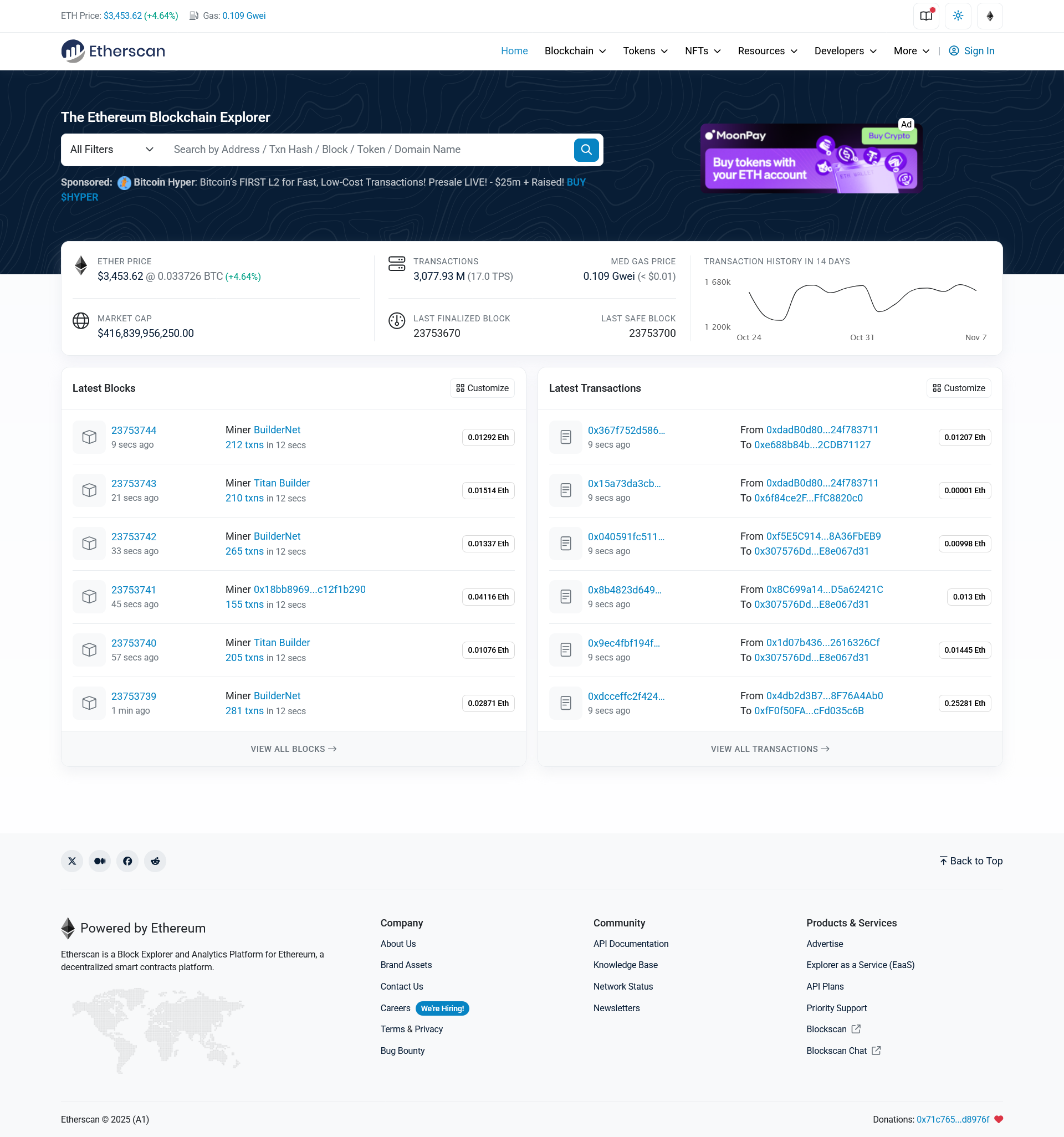
In the rapidly evolving world of blockchain technology, transparency is one of the most revolutionary features. Unlike traditional financial systems where data is locked within centralized institutions, blockchain networks make transaction data publicly accessible. However, raw blockchain data is complex and not easily readable. This is where Etherscan plays a crucial role. As the leading blockchain explorer for the Ethereum network, Etherscan provides a user-friendly interface that allows anyone to search, verify, and analyze transactions, smart contracts, wallets, and tokens on Ethereum.
This article explores what Etherscan is, how it works, its key features, and why it has become an essential tool for crypto users, developers, investors, and researchers.
What Is Etherscan ?
Etherscan is a blockchain explorer specifically designed for the Ethereum network. Launched in 2015, it enables users to access and interpret data stored on the Ethereum blockchain. While Ethereum itself is a decentralized network that records transactions across thousands of computers, Etherscan acts as a search engine that organizes this data into readable and searchable information.
It is important to clarify that Etherscan is not a wallet, nor does it hold or control cryptocurrency. It does not execute transactions. Instead, it reads blockchain data and presents it in a structured format, allowing users to monitor activity on the network.
Why Blockchain Explorers Matter
Blockchains are transparent by design. Every transaction ever made on Ethereum is permanently recorded. However, this information is stored in blocks and encoded in complex data structures. Without a blockchain explorer like Etherscan, accessing this information would require running a full node and understanding technical command-line tools.
Etherscan simplifies this by offering:
. A searchable database of transactions
. Wallet balance tracking
. Smart contract verification
. Token analytics
. Gas fee tracking
This accessibility promotes accountability and trust within decentralized finance (DeFi), NFTs, and other Ethereum-based applications.
Key Features of Etherscan
1. Transaction Lookup :-
One of Etherscan’s most commonly used features is transaction tracking. By entering a transaction hash (TxHash), users can view:
. Sender and receiver addresses
. Amount transferred
. Gas fees paid
. Block number
. Timestamp
. Confirmation status
This is especially useful when verifying whether a transaction has been successfully processed. Since Ethereum transactions may take time depending on network congestion, users can check confirmation progress in real time.
2. Wallet Address Tracking :-
By searching a wallet address, Etherscan displays:
. ETH balance
. Token holdings (ERC-20, ERC-721, ERC-1155)
. Complete transaction history
. Internal transactions
This feature is widely used by traders, analysts, and even journalists to monitor whale activity or verify fund movements. Because Ethereum is pseudonymous rather than anonymous, wallet addresses are visible even though personal identities are not directly attached.
3. Smart Contract Verification :-
Smart contracts are self-executing programs deployed on Ethereum. Etherscan allows developers to verify and publish their contract source code. This transparency allows users to review the code and confirm that it behaves as claimed.
. Verified contracts display:
. Source code
. Compiler version
. Contract ABI (Application Binary Interface)
. Read and write functions
This feature is particularly important in the DeFi ecosystem, where billions of dollars are locked in smart contracts. Code transparency reduces the risk of malicious or hidden functionality.
4. Token Tracking :-
Ethereum supports various token standards, including ERC-20 (fungible tokens) and ERC-721 (NFTs). Etherscan provides dedicated pages for tokens showing:
. Total supply
. Number of holders
. Transfer history
. Contract address
For example, major tokens such as USD Coin and Shiba Inu can be analyzed directly through Etherscan’s interface.
This transparency enables investors to conduct due diligence before interacting with a token.
5. Gas Tracker :-
Ethereum transactions require gas fees. Gas prices fluctuate depending on network demand. Etherscan’s Gas Tracker shows:
. Current gas prices (low, average, high)
. Estimated transaction costs
. Historical gas trends
This tool helps users decide when to send transactions at lower costs and better understand network congestion.
6. Block Explorer :-
Each Ethereum block contains multiple transactions. Etherscan provides detailed information for each block, including:
. Block height
. Miner/validator information
. Number of transactions
. Total gas used
. Block rewards
This feature is useful for researchers and blockchain analysts studying network performance.
How Etherscan Works
Etherscan does not run the Ethereum blockchain itself. Instead, it retrieves blockchain data through Ethereum nodes and indexes it in a structured database. This indexing process allows Etherscan to display searchable and organized information much faster than querying raw blockchain data.
Although it is a centralized service, Etherscan does not alter blockchain data. It merely presents publicly available information in a readable format.
Use Cases Across the Ecosystem
For Investors
. Investors use Etherscan to:
. Verify token legitimacy
. Check transaction confirmations
. Monitor large wallet movements
. Analyze supply distribution
Transparency helps prevent scams, especially in new token launches.
For Developers
Developers rely on Etherscan to:
. Verify smart contracts
. Debug failed transactions
. Analyze gas usage
. Interact with deployed contracts
. It serves as a diagnostic and transparency tool during development.
For NFT Enthusiasts
NFT collectors can track ownership history and minting details of tokens using Etherscan. It provides insights into NFT transfers and contract authenticity.
Etherscan and Network Upgrades
Ethereum has undergone major upgrades, including its transition from proof-of-work to proof-of-stake in 2022, commonly referred to as “The Merge.” Throughout such upgrades, Etherscan has continued adapting its interface to reflect validator data and staking information.
By keeping pace with Ethereum’s evolution, Etherscan remains a critical infrastructure component of the ecosystem.
Security Considerations
Although Etherscan itself is secure and widely trusted, users must be cautious when using blockchain explorers:
. Always verify token contract addresses from official sources.
. Be aware of scam tokens with similar names.
. Do not share private keys (Etherscan never asks for them).
Remember, Etherscan only displays public data. It does not provide custody services or private key management.
Etherscan Broader Impact
Beyond simple transaction tracking, Etherscan has become a transparency layer for decentralized finance. Platforms built on Ethereum—such as decentralized exchanges, lending protocols, and NFT marketplaces—depend on blockchain explorers to maintain public trust.
Its existence reinforces one of blockchain’s core promises: open financial infrastructure where anyone can independently verify activity.
Moreover, Etherscan has expanded to support test networks and additional Ethereum-compatible chains, increasing its utility for developers building across the Web3 ecosystem.
Conclusion
In a decentralized world where trust is minimized and verification is maximized, Etherscan plays an indispensable role. It acts as the bridge between raw blockchain data and human understanding. By providing searchable access to transactions, wallets, tokens, and smart contracts, Etherscan empowers users to independently verify information on the Ethereum network.
As Ethereum continues to power decentralized finance, NFTs, DAOs, and Web3 innovation, tools like Etherscan will remain fundamental to maintaining transparency and accountability. Whether you are a developer deploying smart contracts, an investor tracking token flows, or simply a curious observer exploring blockchain data, Etherscan serves as your gateway into the living record of Ethereum’s decentralized ledger.

AI Website Generator